- Why Does Your Shiba Inu Ignore Your “Come” Command?
- 1. The Three Inconvenient Truths of Shiba Inu Recall
- 2. Why a Long Leash is Essential
- 3. Connecting Trust: Five Specific Phases of Long Leash Training
- 4. Four Major Taboos That Shiba Inu Owners Must Never Do
- Conclusion: To a Shiba Inu, Recall is Not Obedience, but Proof of “A Place to Return”
Why Does Your Shiba Inu Ignore Your “Come” Command?
“My Shiba Inu has a perfect recall inside the house or living room, but the moment we step outside, they completely ignore my voice.”
“The second I let my dog off-leash at the dog park, they ran away like a wild animal, and it took me an hour to catch them. I can no longer bear the fear of letting them off-leash.”
If you are experiencing despair over this behavior from your beloved dog, there is something you need to know first.
It is not because of a lack of effort on your part, nor is it because your dog is unintelligent.
In the global dog training community, the Shiba Inu is often described as stubborn and highly independent, and is widely known as one of the most difficult breeds to train for a recall.
Many experts even advise giving up from the start, saying, “You must never let a Shiba Inu off-leash in an unfenced area.”
However, from my experience facing the true nature of Japanese dogs, what fails to reach their ears is not your voice; rather, your current training approach does not fit the Shiba Inu’s genetic-level psychology.
In this article, we will scientifically explain the inconvenient truth of why general recall training, which is effective for Golden Retrievers and Poodles, does not work for Shiba Inus.
We will then explain in detail the specific training steps using a long leash to cultivate the mindset for them to safely and reliably return to you outdoors, while respecting their high independence.
1. The Three Inconvenient Truths of Shiba Inu Recall
Why does traditional dog training fail when it comes to Shiba Inu recall?
There are three cruel realities caused by this breed’s unique primitive psychology and human misunderstanding.
Truth 1: To Them, the Outside World is More Attractive Than Treats
The typical praise-based training method teaches, “When the dog returns, take a high-quality treat out of your pocket and give it to them.”
Inside the house or in a boring yard, this certainly works.
But what happens once you step outside?
A squirrel crossing in front of them, leaves shaking in the wind, scents left by other dogs, and the pleasure of running freely without obstacles.
To a Shiba Inu, these are massive rewards that cannot be compared to a dry cookie or a piece of cheese in a human’s pocket.
Shiba Inus are highly rational and intelligent. They are always weighing their options in their heads.
“The value of returning there to get one tiny treat” versus “the value of enjoying freedom as is.”
Since they have high independence, they will choose the latter with a high probability. This is why training that only lures them with objects fails outdoors.
Truth 2: Pulling Them Back by Force Accelerates Their Flight Instinct
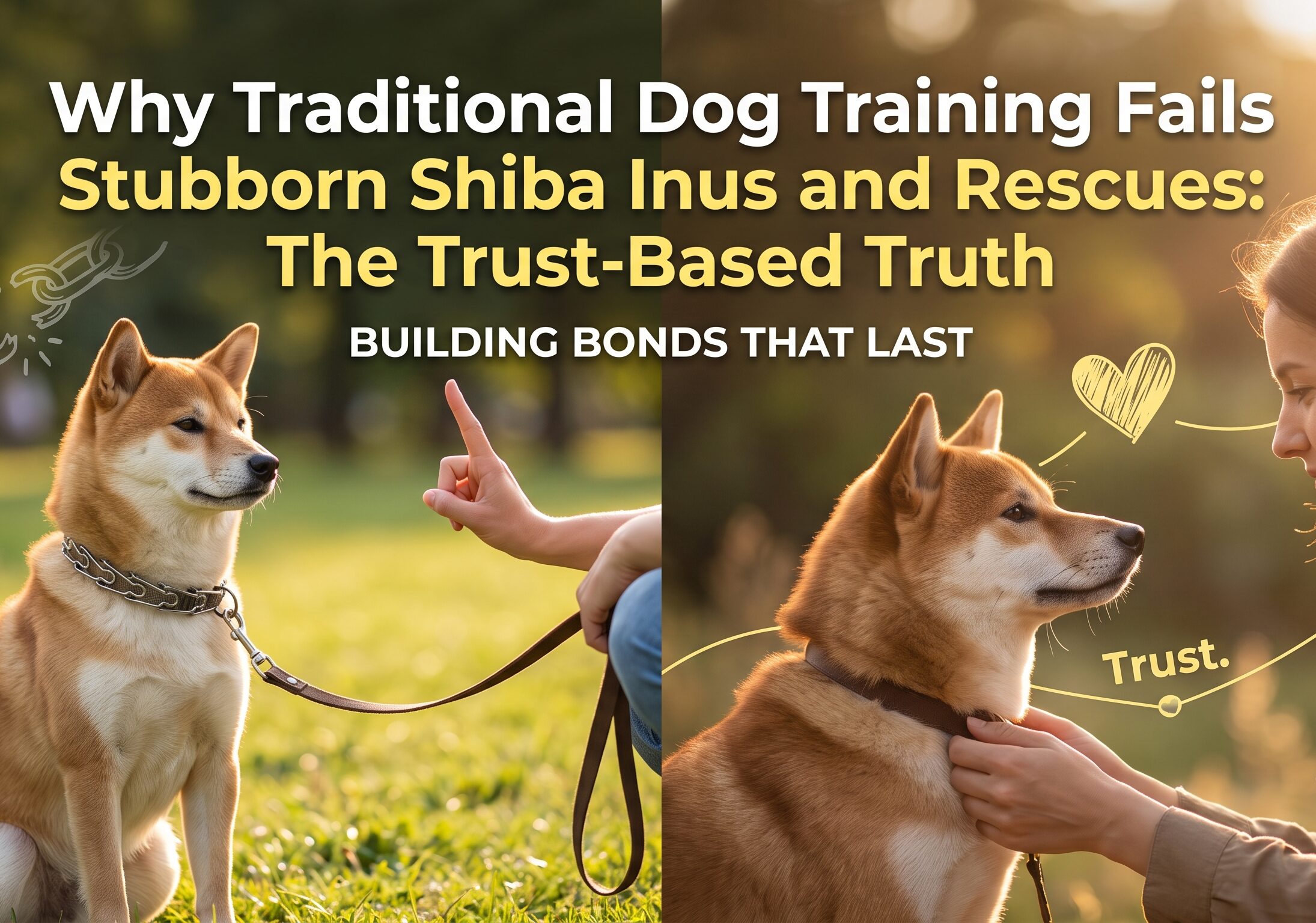
On the other hand, trainers who use traditional training methods or strict discipline will pull the leash hard to give a shock or use punishment tools when a dog ignores a command.
This is the worst possible option for a Shiba Inu, or a hyper-vigilant rescue dog.
Intelligent and independent Shiba Inus develop a distrust toward anyone who inflicts pain and perceive them as someone to be avoided.
A dog pulled back by force learns that “when I return to my owner, bad things happen” or “being near my owner is dangerous.”
As a result, the next time the leash comes off, they will run further away and flee more desperately.
Control through fear fundamentally destroys the most important relationship of trust.
For Japanese dogs, where trust is more important than anything, giving punishments creates a fatal rift in the relationship between the owner and the dog.
Truth 3: Chasing After Them to Catch Them Becomes a Fun Game
When a dog runs away, humans panic and chase after them while shouting, “No! Come back!”
However, to a Shiba Inu, this looks like a fun chase game where the owner is running after them to play.
The more desperate you become, the more their eyes shine as they enjoy the escape.
Or, if they have had a past experience of being severely scolded after being caught, the worst-case formula of “returning is the end of freedom and the beginning of scolding” is completed in their minds.
Because of this, they learn to keep running away while maintaining an exact distance just out of human reach.
2. Why a Long Leash is Essential
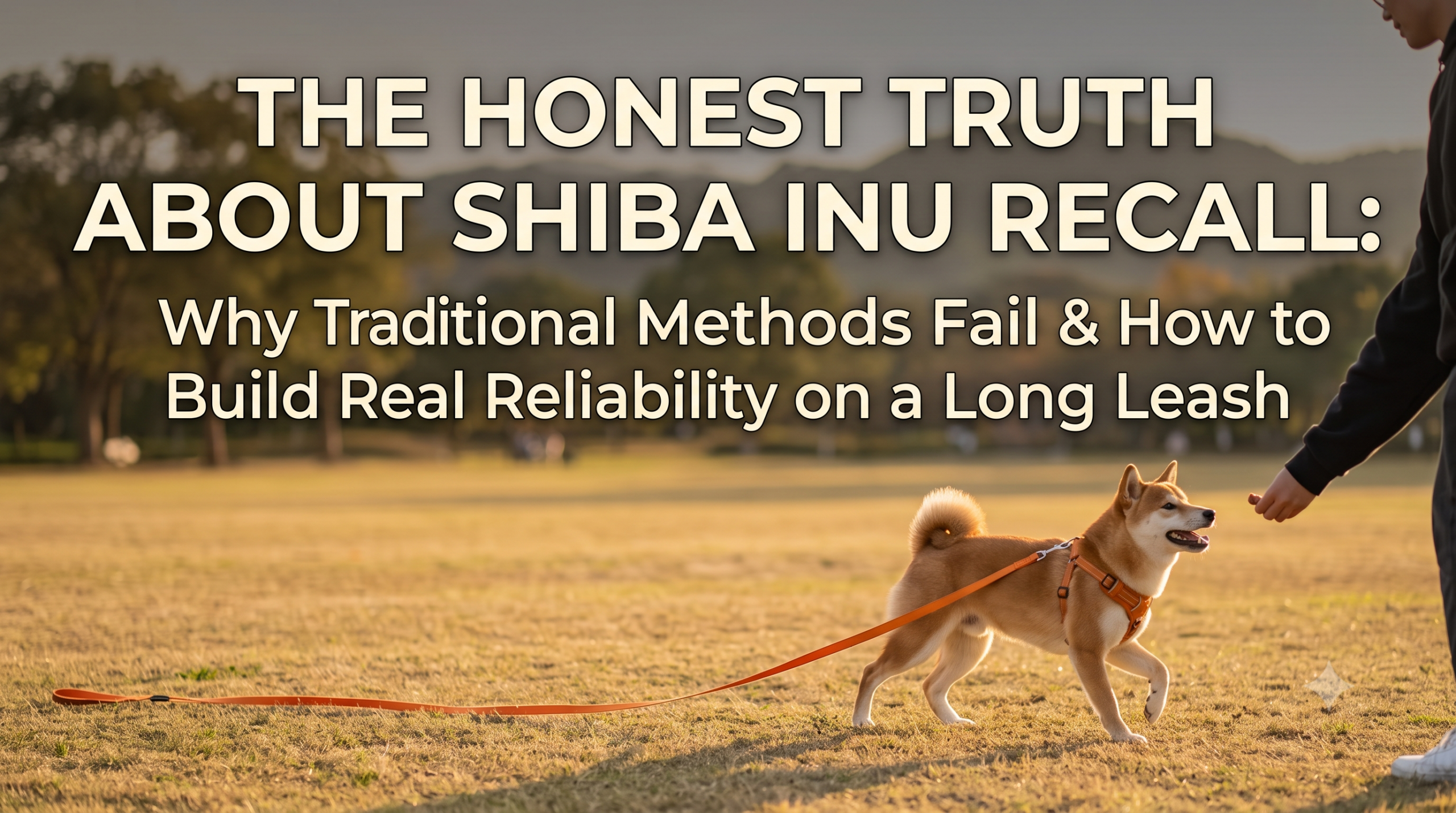
The only correct answer to secure a Shiba Inu’s recall is to “let them choose to return 100% voluntarily in an environment where they are not given the successful experience of escaping.”
The essential tool for this is a long leash with a length of about 5 to 15 meters.
What you must clearly recognize here is that a long leash is not a tool to forcefully drag the dog back.
It is a “safety line to test the connection with the owner by creating a simulated free space outdoors while ensuring the dog’s safety.”
Absolute Conditions for Choosing Tools
A Shiba Inu’s explosive running ability is beyond human imagination.
As dogs that once active as hunting dogs, they run through even places with bad footing, like mountains and forests, at incredible speeds, chasing prey and running away out of sight in an instant.
A cheap, thin string-type long leash made of nylon not only causes severe friction burns to human hands when the dog suddenly runs, but also tangles in the grass, putting the dog into a panic.
Recommended options are flat leashes with a special resin coating that is waterproof, resistant to mud and water, and does not easily tangle even when dragged on the ground, or lightweight, high-strength round ropes.
Since these glide smoothly over the ground, even if the dog suddenly runs, it is easy for the owner to control and stop the dog by instantly stepping on the leash with their foot.
Additionally, to ease the shock to the dog’s neck, it is an ironclad rule to attach a harness designed not to compress the airway, rather than a collar.
3. Connecting Trust: Five Specific Phases of Long Leash Training
Now, we will explain the specific steps to naturally draw your Shiba Inu’s mind back to you and build a reliable recall outdoors.
The goal of this training is not to control them by force, but to create a consciousness where “no matter how far away they are, they turn around and return on their own when they hear the owner’s voice.”
Phase 1: Minimize the Level of the Environment
Do not start in a park or dog run with many distractions.
First, choose a place with few distractions for the dog, such as an empty weekday parking lot or a boring field with a clear view.
Attach the long leash and let them sniff around freely while dragging it on the ground. At this stage, do not use the recall word at all.
Phase 2: Capture “Voluntary Eye Contact” Without Words
When the dog is moving freely within the range of the leash, there is a moment when they suddenly look back at you.
Do not miss that moment of checking, “Where is my owner?” and immediately praise them in a high voice.
Then, instead of you approaching the dog, you run backward 2 or 3 steps.
This stimulates the Shiba Inu’s dynamic vision and tracking instinct.
When the dog runs toward you, drop the highest-value food right at your feet, which is the closest place to your body.
Before calling them back with words, implant this formula in their brain: “If I pay attention to my owner and approach them, I get the fun of chasing a moving target and the best reward at the same time.”
Phase 3: Releasing Pressure Using Leash Slack
When the dog is absorbed in sniffing, completely ignores you, and tries to go to the limit of the leash, do not pull the leash hard. Keep the leash taut and stand still in that spot like an anchor.
The dog will not be able to move forward any further and will feel the resistance.
At that time, the moment the dog wonders why, slacks the leash, or looks back at you, immediately praise them, completely slacken the leash, and welcome them with a smile.
Through this, the dog learns: “When the leash becomes taut, if I turn my attention to my owner, the unpleasant tension disappears and good things happen.”
It is important to let the dog think on their own, “How can I make this tension disappear?” rather than using physical punishment.
For an intelligent dog, rather than controlling them with simple punishments like pain, letting them think on their own, “How can I solve this problem?” and connecting their high intelligence to good results is the most effective training.
Phase 4: Introduce the Recall Signal Here for the First Time
Once Phase 2 and 3 are perfect and the dog frequently pays attention to you even outdoors, introduce the recall word (such as “Come” or “Here”) for the first time.
Watch for a moment when the dog is a few meters away from you and looks bored without being absorbed in anything, and say the word clearly and brightly only once.
When the dog turns to look at you, draw them in while moving backward, just like in Phase 2.
If they seem likely to ignore you, simply vibrate the leash gently and slightly with your fingertips to direct their attention to you.
Never drag them in by force.
When they return, rejoice exaggeratingly like never before, and praise them with plenty of rewards.
Phase 5: Gradual Addition of Distractions and Distance Automation
In the final phase, move to an environment with some distractions (such as a place where people are walking far away, or a grassy area where the scents of other dogs remain).
Extend the length of the leash to 10 meters and then 15 meters.
The ultimate goal here is to create a cognitive state where, even without saying a word, “the dog slows down on their own and keeps a constant distance from the owner before running away and reaching the limit of the leash.”
When the Shiba Inu truly understands that “being too far from my owner is boring, and being close is safe and fun,” the long leash will remain slack and evolve into an invisible leash of trust.
Behaving while keeping the owner’s figure in sight is also a natural behavior of Japanese dogs.
This connection based on a relationship of trust where being by the human’s side is the best thing is also the most important thing in a relationship with a Shiba Inu.
4. Four Major Taboos That Shiba Inu Owners Must Never Do
When proceeding with long leash training, a single mistake can ruin months of effort.
Please absolutely avoid the following four actions.
① Using the Recall Word to Catch Them
This is the act of using the recall word to catch the dog when they approach for things they dislike, such as putting them in the car, going home, or doing grooming like brushing and nail clipping.
If you do this, the Shiba Inu will learn in one shot that “that word is a signal for a trap.”
When going home or restraining their body, quietly pull the leash in without speaking, or walk quietly to the dog from the owner’s side to secure them.
② Repeating the Word When the Dog Ignores It
If you repeat “Come! Come! Come!”, the word degrades into mere background noise.
The signal must be given only once. If ignored, do not repeat the word, but lightly shake the leash or make a strange movement yourself to attract their interest and regain their attention visually.
③ Scolding the Dog When They Return
This is when you finally catch the Shiba Inu that was running around and scold them out of anger, saying, “Why don’t you listen!”
While this is understandable as a human emotion, to the dog, it only becomes a memory of “when I finally returned to my owner, a scary punishment was waiting.”
Make sure to thoroughly maintain that “no matter how much they ran around, the moment they return is always the safest and happiest place in the world.”
④ Making Them Completely Off-Leash Without 100% Confidence
Just because they did it perfectly on a long leash, you should be extremely cautious about letting them completely off-leash in an unfenced public place.
Shiba Inus retain a strong primitive hunting instinct.
The moment they see a rabbit, cat, or bird crossing in front of them, their brain returns to the wild, and the human voice is physically shut out.
Do not forget the reality that “this relationship of trust is maintained precisely because the long leash is attached.”
Conclusion: To a Shiba Inu, Recall is Not Obedience, but Proof of “A Place to Return”
Many dog owners tend to make “making the dog obedient” the goal of training.
However, if you demand that from a Shiba Inu or a hyper-vigilant rescue dog, they will close their hearts or respond with defensive aggression.
To a Shiba Inu, a perfect recall is not about you becoming the boss and dominating them.
It is an intimate behavior born as a result of the dog themselves firmly believing, while recognizing their high independence and wild instincts, that “in this wide world, being next to that person is the safest, most exciting, and most special place.”
Is what travels from your hand holding the long leash the tension of forced control? Or is it the warmth of trust gently watching over their freedom?
There is no need to rush.
Through a single long line, let’s weave a mental bond with your dog little by little, but one that will never break.
Beyond that, a supreme partnership awaits, where you trust each other and feel the wind in the vast nature.
Comments