
You lure them with a treat, but your dog completely ignores you. You pop the leash to give a correction or use a loud noise to startle them, only to be met with a low growl and a defensive bite.
If you are struggling to fix behavioral issues with your beloved Shiba Inu or rescue dog and feel like every mainstream dog training method has failed you—please, stop blaming yourself. And never despair, thinking your dog is an untrainable, aggressive basket case.
You haven’t failed because of a lack of effort, nor is your dog “dumb.” The truth is, traditional dog training methods blanketing the internet are fundamentally unsuited for dogs with the unique, primitive psychological profiles of Shiba Inus and rescues.
Through years of experiencing the rehabilitation of notoriously difficult Japanese breeds, wild feral dogs, and rescues labeled as dangerous biters, I can tell you one thing with absolute certainty.
What these dogs needed to be saved was never high-value treats or forceful dominance. It was one thing and one thing only: building an unshakeable bond of trust.
In this article, we will break down the scientific and psychological reasons why conventional obedience training fails Shiba Inus and rescues. More importantly, we will explore a professional, professional-grade approach to opening their hearts and unlocking their true potential.
- 1. The Primitive Psychology Shared by Shibas and Rescues
- 2. The Limitations of Purely Positive, Treat-Based Training
- 3. Why Balanced and Aversive Training Makes Matters Worse
- 4. The Only Real Solution: Rebuilding the Human Mindset
- 5. The 5 Practical Steps to Rebuilding Real Trust
- Conclusion: Your Dog Can Become Your Greatest Companion
1. The Primitive Psychology Shared by Shibas and Rescues
Why do training methods that work flawlessly on Golden Retrievers or Poodles fall completely flat with Shiba Inus and rescue dogs? The answer is deeply hardwired into their DNA: primitive survival instincts.
The Shiba Inu: A Wolf in a Dog’s Body
Recent genetic studies have proven that the Shiba Inu is one of the closest relatives to the wolf among all modern dog breeds.
They are not companion lapdogs whose sole purpose or joy in life is to please humans or mindlessly obey commands. Instead, they possess an intense sense of independence, sharp vigilance, and acute survival instincts.
If a Shiba Inu does not see the logical sense or benefit of a command, they simply choose not to comply.
While the Western world often labels this trait as “stubbornness,” that is merely a human misconception. They are not stubborn; they are highly intelligent animals capable of independently assessing their own safety and self-interest.
The Rescue Dog’s Trauma and Survival Mode
On the other hand, rescue dogs—particularly former street dogs, feral rescues, or those who survived abuse—have lived in environments where their lives were constantly threatened. Their brains are locked into a permanent state of “survival mode.” They hyper-analyze every minor human movement to determine whether it represents a lethal threat.
Whether it is a Shiba with primitive traits or a rescue stuck in survival mode, both share a common, cold calculation: they are constantly judging whether the human standing in front of them is truly a safe and worthy partner.
In their logical world, you do not hand over your survival to someone you cannot 100% trust.
2. The Limitations of Purely Positive, Treat-Based Training
In the modern dog training world, positive reinforcement—using treats and praise without physical force—is widely considered the gold standard. It is a humane and beautiful philosophy.
However, a purely transactional relationship based solely on “I give you food, you do this for me” has severe limitations. It cannot fundamentally solve deep-seated behavioral issues, such as severe aggression, defensive biting, or intense resource guarding.
Fear and Survival Instincts Easily Trump Appetite
When a dog’s defensive instincts explode because of deep distrust or terror—growling, “Back off or I will bite”—waving a piece of premium steak or a high-value treat in front of their nose is completely useless.
The dog’s brain is flooded with adrenaline and cortisol. They are physiologically incapable of feeling hunger when they believe they are fighting for their lives. Attempting to bribe a terrified dog with food can actually backfire, compounding their anxiety and making them distrust you even more.
When the Treats Stop, the Cooperation Ends
Treat-dependent training teaches intelligent dogs to calculate: “I only need to listen when there is food on the table.”
Shiba Inus, with their sharp minds, see right through this system almost instantly.
The moment their desire to protect their own body or guard a prized possession outweighs the value of the treat you are holding, they will swiftly slip out of your control.
Treats are excellent tools for teaching mechanics like a sit or a paw. However, they are not a currency that can buy a deep, life-or-death bond of mutual trust.
3. Why Balanced and Aversive Training Makes Matters Worse
When treats fail, pivoting to aversive, punishment-based training is the most dangerous path a dog owner can take.
Relying on aversion tactics—such as shock collars (e-collars), prong collars, leash pops, or startling noises—injects profound toxicity into the relationship.
For Shiba Inus and rescue dogs, applying physical force or punishment is the equivalent of pouring gasoline onto a roaring fire.
The Absolute Collapse of Trust
To a feral dog or a traumatized rescue, physical pain or fear inflicted by a human acts as absolute confirmation: “Yes, humans are terrifying predators out to harm me.”
These dogs do not want to be dominated or forced into submission; they want to feel safe and secure.
The harder you try to suppress them through force, the harder they will fight back, risking their lives to defend themselves.
Many feral dogs labeled as “hopelessly dangerous biters” were never truly aggressive; they were simply reacting out of pure survival panic when cornered. Once they realized the human in front of them was safe and the panic subsided, they willingly accepted human touch.
When a dog is still testing whether you are a friend or a foe, inflicting pain or fear is an explicit declaration of hostility. It must be avoided at all costs.
Internalized Aggression and Behavioral Shutdown
Dogs shut down by physical force may suddenly appear quiet, calm, or “obedient.”
In canine behavioral science, this is known as “learned helplessness”—a highly volatile psychological state where a dog completely closes off their mind.
The dog has not become submissive; they have simply suppressed their emotional output because they realized resistance is futile in that moment. But the intense stress continues to build internally until one day, it explodes without warning into a catastrophic, devastating bite.
A dog’s growl is a life-saving warning sign that says, “Please don’t come any closer.”
If you punish the growl, you successfully strip the dog of their warning system. You create a ticking time bomb—a dog that skips the warning entirely and goes straight for a biting attack. Traditional punishment does not cure behavioral issues; it merely compresses them into a far more lethal explosion.
4. The Only Real Solution: Rebuilding the Human Mindset
How, then, do we break through to them?
The answer is elegantly simple: stop bribing, stop dominating, and rebuild a foundation of trust from scratch.
Japanese breeds like the Shiba Inu will not always come running just because you call their name. Because they possess the cognitive intelligence to make their own choices, they will easily ignore a call if something else catches their attention. Yet, once they truly trust a handler, they will never leave your side, maintaining a natural, respectful distance while shadowing your every move.
One of the wildest feral dogs I ever rehabilitated refused to take food from a human hand and would bite to the bone if anyone dared approach his space.
He didn’t transform because I showed off flashy training techniques.
He transformed because I proved to him, day after day, that I was a completely predictable, non-threatening entity who fiercely respected his boundaries.
To build this level of trust with a Shiba or rescue, you must immediately discard old misconceptions and adopt a new mental framework.
Eradicating the Myth of Dominance
The outdated “alpha wolf” theory—the idea that you must dominate your dog or pin them to the floor to teach submission—has been completely debunked by modern veterinary behavioral science.
If you attempt to alpha-roll a primitive breed, they will perceive it as a lethal threat and fight back with maximum, bone-crushing force. Your goal is never a master-servant dynamic; it is a trusted partnership.
Consistency and Predictability Are Everything
A dog measures trust through absolute predictability: “I know exactly what this human will do next, 100% of the time.” Reacting based on human emotion—screaming in anger one day and over-pampering the next—leaves a primitive dog in a state of profound anxiety.
Furthermore, you must read and honor their subtle signs of discomfort (whale eyes, pinned ears, lip licking, body freezing) and never force an interaction. Your mere presence should radiate an energy that makes their world feel safe. Do not aim to be a loud, aggressive boss who demands control; aim to be a calm protector whose strength makes the dog feel safe.
5. The 5 Practical Steps to Rebuilding Real Trust
To completely overhaul your relationship with your dog, strip away superficial obedience gimmicks and follow these five battle-tested steps.
Step 1: Execute a Complete Decompression Period
If you have just brought a rescue dog home, or if your relationship has completely deteriorated into severe biting incidents, cease all formal training and obedience immediately.
In rescue circles, the “3-3-3 rule” states that a dog needs 3 days to decompress, 3 weeks to learn your routine, and 3 months to feel at home. For primitive, wolf-like breeds, this timeline can easily double or triple.
Isolate your dog in a safe zone, such as a secure crate or a designated pen. Do not force physical touch. Do not stare directly into their eyes. Simply exist in the same room as a quiet, harmless, and neutral presence for several weeks until their baseline stress drops.
Step 2: Establish Radical Boundary Respect and Observation
Study your dog’s triggers and comfort zones intensely from a distance.
Never approach your dog while they are eating a meal or chewing on a high-value toy.
This is the fastest way to trigger resource guarding, a deeply ingrained survival instinct. Consistently demonstrate through your body language—turning your back, keeping your distance—that you have zero intention of stealing their territory or possessions.
Step 3: Utilize Safety Gear to Remove Human Fear
In the rehabilitation process, if you harbor internal fear or tension (“What if my dog bites me?”), that panic bleeds out through your elevated heart rate and rigid posture. Dogs read this instantly, causing them to panic in return.
To break this cycle, you must temporarily utilize safety equipment. These tools are never used to restrain or punish the dog; they are armor designed to give you peace of mind so your dog never feels the need to resort to defensive biting.
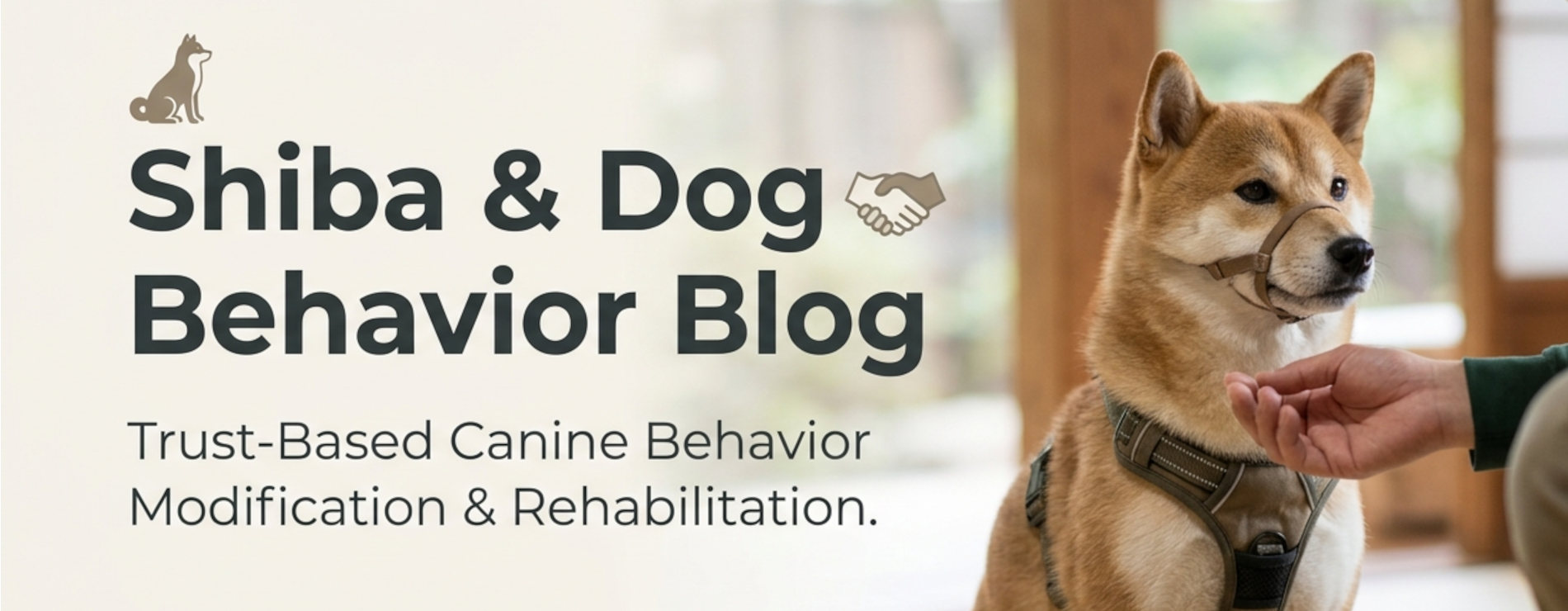
Many owners feel immense guilt using a muzzle. But look at it this way: A muzzle is a safety helmet for your dog. It ensures that even in a panic, they can never make a mistake that would legally mandate quarantine or euthanasia.
Avoid trying to train the dog to get used to the muzzle right away. At first, it is the human who should practice putting the muzzle on quickly without being bitten, while keeping the dog as unafraid as possible. Never abandon essential safety gear out of misguided guilt; use it to protect your dog from catastrophic legal consequences.
Step 4: Transforming Your Presence into the Ultimate Reward
Once your dog’s hyper-vigilance begins to soften, alter how you feed them. Instead of placing a food bowl directly on the floor, walk past and quietly drop a single kibble near your feet.
Do not force them to eat directly from your hand. This pressure-free approach allows the dog to process a vital fact at their own pace: “This human does not take away resources; this human is the source of all good things.” Gradually, their focus shifts away from the physical treat and transforms into profound trust in your very existence.
Step 5: Leveraging the Long Line for Distance-Based Trust
Once trust is established indoors, you can begin building a reliable recall outdoors.
The inability to get a dog to return when called is the number one complaint of Shiba Inu owners worldwide.
By building on basic recall mechanics and tailoring them to the independent nature of primitive breeds, you can achieve a highly reliable return.
Acquire a heavy-duty long line (10 to 15 meters / 30 to 50 feet) and head to a secure, wide-open area. Never use the leash to yank or mechanically pull the dog back. Keep the line completely slack, granting them an illusion of total freedom. Call their name. The split second they turn their head to look at you, open your arms with a genuine smile and a warm, inviting voice. If your dog is comfortable being touched, throw a celebratory party with gentle physical praise.
You are teaching the dog a fundamental truth: “Returning to my human does not mean losing my freedom; it means returning to the safest, most rewarding place on Earth.”
As they master this, shorten the distance slightly and practice walking together. When a dog genuinely views you as a safe haven rather than an adversary, they will naturally choose to maintain a comfortable, connected distance right beside you. The same rule applies to rescues: they must deeply understand that being by your side is the ultimate sanctuary from the chaos of the world.
Conclusion: Your Dog Can Become Your Greatest Companion
True dog training is not about engineering a mechanical robot that obeys commands flawlessly for human convenience.
It is a profound, mutual contract between two entirely different species with distinct instincts, built on respect and understanding.
Primitive breeds like the Shiba Inu and battle-scarred rescue dogs possess a wild beauty and acute survival intelligence. They see right through superficial training hacks and manipulative shortcuts.
But the moment you understand their fear, lay down your need for dominance, and offer unwavering, predictable trust—they will reward you with a fierce loyalty and a depth of love unmatched by any other breed on Earth.
Take a deep breath. Stop relying on treats to buy their affection, throw away the fear, and start listening to what their behavior is trying to tell you. That is the exact moment your true journey begins.

Comments